
The Fatal Five Fundamentals
NADSP ACCREDITED
ONLINE COURSE
The Fatal Five Fundamentals
Course Description:
IntellectAbility collaborated with the University of Georgia and the Georgia Department of Behavioral Health and Developmental Disabilities, with guidance from the Department of Justice, to produce a series of eLearn courses discussing the Fatal Five conditions considered preventable causes of death in people with intellectual and developmental disabilities (IDD). The Fatal Five Fundamentals is part of our suite of Fatal Five training.
To be effective, courses for IDD support services require insight into the unique health risks of people with IDD. Our self-paced eLearning courses are filled with videos, interactive exercises, and visual aids to support training, with content designed to consistently engage students and improve data retention. The result is a student at any educational level who feels empowered to observe, make informed decisions, and take action.
Course Duration: 4-6 Hours
What You’ll Gain
The Fatal Five Fundamentals is intended to assist both clinical and non-clinical staff in supporting adults with intellectual and developmental disabilities. Being aware of the Fatal Five is critical for providing adequate support and appropriately targeting treatment needs.
What Are the Fatal Five Conditions?
The Fatal Five refers to the top five conditions linked to preventable deaths of people in long-term services and supports (LTSS) or in community-based residential settings. The Fatal Five Fundamentals course is intended for clinicians and other supporters who require knowledge of the Fatal Five to provide appropriate care and support.
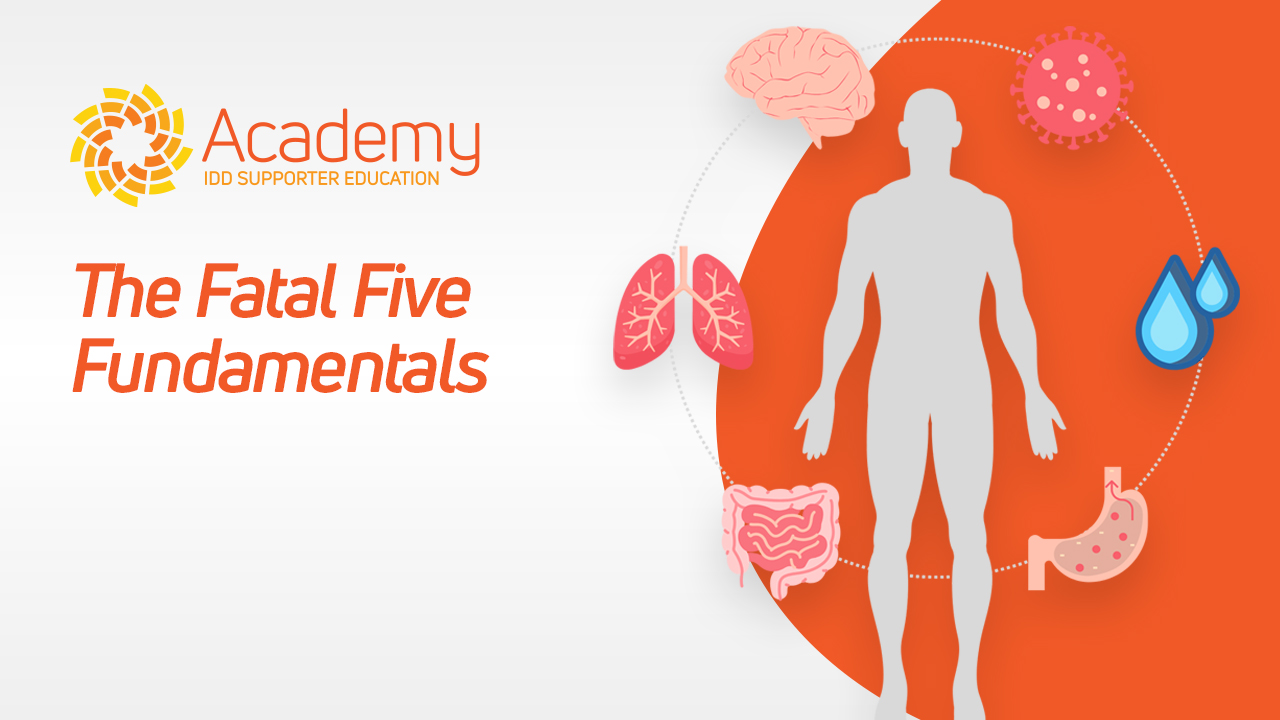
While the issues can differ in order of frequency depending on the population being represented, the five conditions most likely to result in death or health deterioration for people with IDD are:
- Aspiration
- Bowel Obstruction
- Dehydration
- Seizures
- Infection/Sepsis
For non-clinical staff, the focus is on infection, since one cannot develop sepsis without it. Clinical staff will monitor for sepsis, while non-clinicians should focus on preventing and treating infections.
How This Course Works
This course can be hosted within an existing SCORM-compliant learning management system (LMS) or accessed through IntellectAbility’s electronic Learning Platform (eLP). Learners progress at their own pace, with course completion tracked and certificates generated upon successful completion.
Request More Information
Contact us today for a free preview and custom price quote to license for your entire agency.
Synopsis by Module
1. ASPIRATION
Module Length: 30 Minutes
This module covers the fundamentals of Aspiration. Included are the anatomy of the airway and how positioning and safe-eating techniques can reduce the risk of foreign-body airway obstruction.
After this module, you should be able to:
-
- Recognize the basic structures of the respiratory tract.
- Identify the signs and symptoms of aspiration and what may cause it.
- List 2 action steps to take if aspiration occurs.
2. BOWEL OBSTRUCTION
Module Length: 37 Minutes
This module covers the fundamentals of Bowel Obstruction and related conditions, including fecal impaction and constipation. It discusses the causes, signs, symptoms, and what support staff can do to prevent or support them.
After this module, you should be able to:
-
- Recognize the basic structures of the gastrointestinal tract.
- Identify signs of healthy and unhealthy bowel function.
- List 2 action steps to take if bowel obstruction occurs.
3. DEHYDRATION
Module Length: 27 Minutes
This module covers the causes and risks of dehydration. It includes the signs that staff should watch for and discusses what to do when.
After this module, you should be able to:
- Define dehydration and recognize the importance of fluid intake.
- Identify the common signs and symptoms of dehydration.
- List 2 action steps to take if dehydration occurs.
4. SEIZURES
Module Length: 36 Minutes
This module provides staff with the basic information they need on seizure types and manifestations, along with directions on what to do before, during, and after a seizure.
After this module, you should be able to:
- Define seizure and seizure types.
- Record accurate observation of seizure activity.
- List 2 action steps to take when a seizure occurs.
5. INFECTION
Module Length: 31 Minutes
This module teaches case managers about the serious risks of infections, including how to prevent them, how to spot them, and what can happen if they are not treated. Infection is considered a precursor to sepsis, which is one of the ways an infection can become fatal.
After this module, you should be able to:
-
- Know what an infection is and how it can occur.
- Identify the signs and symptoms of an infection.
- List 2 action steps to take when an infection occurs.
6. GERD (GASTROESOPHAGEAL REFLUX DISEASE)
Module Length: 31 Minutes
This module covers the essential information on Gastroesophageal Reflux or GER. It covers the causes, risks and actions that can minimize those risks, especially aspiration. After this module, you should be able to:
- Define GERD.
- Identify how to recognize symptoms of GERD.
- List 2 action steps to take when a person experiences GERD.
7. WHEN TO ACT
Module Length: 33 Minutes
This module covers common conditions that may be present in persons with I/DD, such as skin conditions, diabetes, falls and other common scenarios. It covers each separate scenario in detail and when and how to act for each.
After this module, you should be able to:
- Learn common conditions that may be present in persons with I/DD.
- Recognize 2 signs of each condition.
- List 2 action steps to take for each of the conditions discussed.